Water Damage Restoration Denver

Structural Drying & Dehumidification Denver

Drying is measured, not guessed. Restoration technicians follow the ANSI/IICRC S500 standard, which defines a "dry standard" as the equilibrium moisture content of unaffected materials in the same structure, so a…

Get My Free Estimate →
Structural Drying & Dehumidification in Denver, CO
Quick answer
  • Included: moisture mapping, placement of air movers and dehumidifiers, daily moisture readings, and a documented dry log until materials hit their target moisture content.
  • How fast: most residential jobs reach dry standard in 3-5 days; dense materials like hardwood over concrete or double-layer drywall can run 6-10 days.
  • What it costs: a typical Denver drying setup runs about $2,000-$6,000, driven by the number of days and machines; large or multi-room losses go higher.
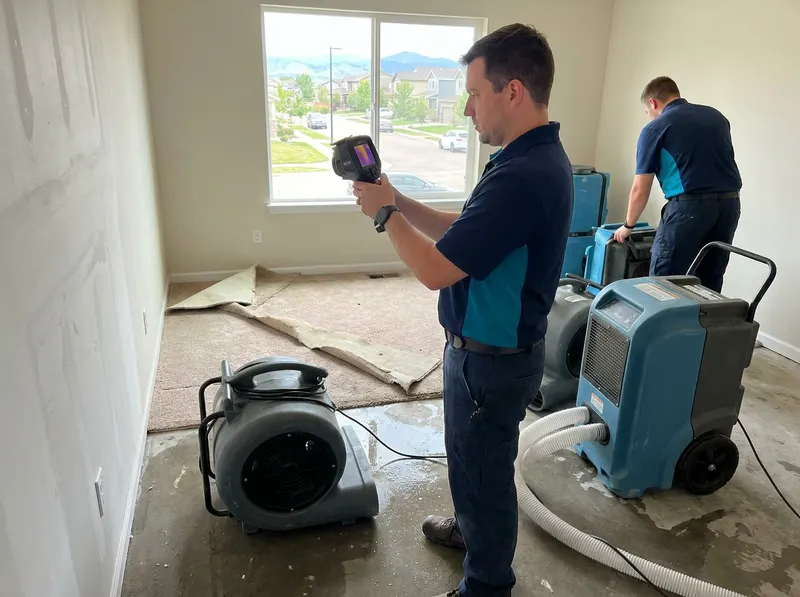
  • What's used: LGR (low-grain refrigerant) dehumidifiers, axial and centrifugal air movers, penetrating and non-penetrating moisture meters, and thermal imaging.
  • How to book: call for a same-day on-site moisture assessment; a text with a photo of the affected area gets a faster ballpark.

Drying is measured, not guessed. Restoration technicians follow the ANSI/IICRC S500 standard, which defines a "dry standard" as the equilibrium moisture content of unaffected materials in the same structure, so a hardwood floor in a Wash Park bungalow might target 7-9% moisture content, while framing lumber targets under about 16%. A penetrating meter reads inside the material and a non-penetrating meter scans behind it; readings are logged daily so the equipment stays in place only as long as the numbers require.

Denver's climate speeds this work. The Front Range sits near 5,280 feet with average relative humidity often in the 30-50% range, so ambient air is already dry, which shortens many drying cycles compared with humid coastal cities. That said, spring snowmelt off the foothills, summer monsoon downpours, and winter pipe bursts in older neighborhoods like Capitol Hill, Baker and Berkeley produce the bulk of local losses. Basements in Highlands and Sloan's Lake homes with cinder-block or poured foundations hold moisture in the concrete long after the standing water is gone, which is why concrete and below-grade framing frequently need the longest dry times.

The sequence is straightforward. First, standing water is extracted. Second, wet materials are mapped with meters and thermal imaging to find hidden moisture behind baseboards and inside wall cavities. Third, air movers are positioned to sweep the wet surfaces while LGR dehumidifiers pull the released vapor out of the air. Fourth, moisture readings are taken every 24 hours and equipment is adjusted. Fifth, drying stops only once each material matches the documented dry standard. Wall cavities are often dried through small drilled holes or by removing baseboard rather than tearing out drywall, which keeps repair costs down when the framing is salvageable.

A drying-only approach fits a clean-water loss caught early, a supply-line leak or an appliance failure where the drywall and flooring are still structurally sound and can be dried in place. When water sat for days, when insulation is saturated, or when the loss involves sewage or ground water, some materials must be removed rather than dried, because saturated fiberglass insulation and swollen particleboard rarely return to standard. The trade-off is time versus material loss: drying in place saves demolition and rebuild cost but adds days on the meters, while removal is faster to "dry" but adds materials and labor to the rebuild. A single wet room typically needs 2-4 air movers and one dehumidifier; a flooded basement can need 8-12 air movers and multiple units running continuously.
Structural Drying & Dehumidification cost in Denver

Single-room drying (3-4 days, small equipment set)$1,200-$2,500
Typical multi-room residential drying setup$2,000-$6,000
Flooded basement drying (8-12 air movers, multiple LGR units)$4,000-$9,000+
Per dehumidifier, per day$95-$160
Per air mover, per day$30-$60
Daily moisture monitoring / dry-log visit$85-$175 per visit

Every job gets a firm, written price after a free on-site visit.

Common questions

How long does structural drying take in Denver?
Most Denver homes reach dry standard in 3-5 days. Denver's low ambient humidity (often 30-50% at 5,280 feet) helps drying finish faster than in humid climates, but dense materials like hardwood over concrete slab or below-grade block foundations can extend to 6-10 days.
Do I need drying if the water is already gone in my Denver home?
Yes, visible water being gone does not mean the structure is dry. In Denver homes, moisture stays trapped inside wall cavities, subfloor and concrete for days; a moisture meter reading above the material's dry standard means active drying is still needed to prevent mold and warping.
Will my walls have to be torn out for drying in Denver?
Not always. In many Denver jobs, wall cavities are dried through baseboard removal or small drilled ports and directed airflow, so intact drywall can stay in place. Removal is used when insulation is saturated or the loss involves sewage or ground water, where materials cannot return to standard.
What equipment is used for dehumidification in Denver?
Denver structural drying uses LGR (low-grain refrigerant) dehumidifiers paired with axial and centrifugal air movers, plus penetrating and non-penetrating moisture meters and thermal imaging cameras. The number of units scales with the loss, a single room often needs one dehumidifier and 2-4 air movers.
How much does dehumidification cost after water damage in Denver?
A typical Denver drying setup runs about $2,000-$6,000, with single-room jobs closer to $1,200-$2,500 and flooded basements $4,000-$9,000 or more. Cost is driven by days on the meters and machine count; the exact figure is confirmed on a free on-site moisture assessment.

Get started today

Tell us about your structural drying & dehumidification job in Denver and we'll send a clear, written quote, usually the same day.

Get your free water damage restoration quote, Denver

We only use your ZIP to check availability, no spam.