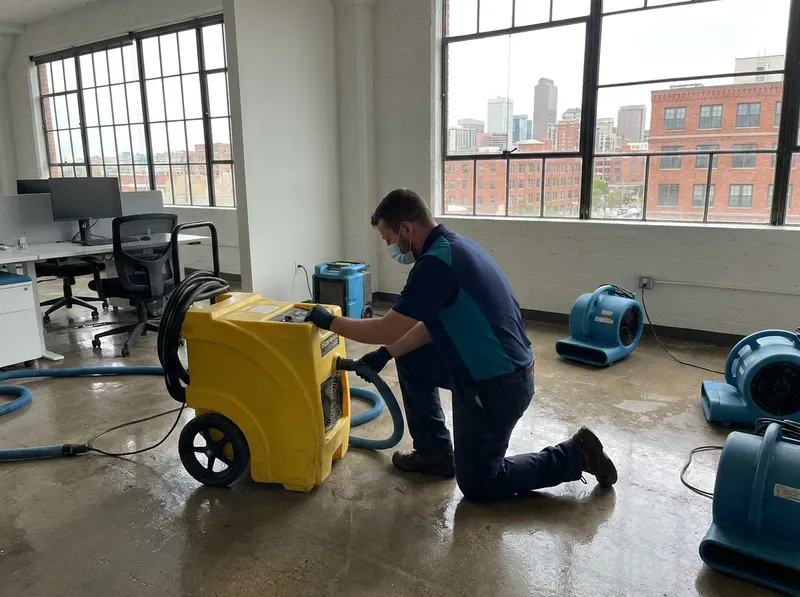
Commercial losses differ from residential jobs because a Denver business loses revenue for every hour a space stays closed. A flooded ground-floor retail unit in Cherry Creek, a saturated LoDo restaurant kitchen, or a warehouse near the Central Park (Stapleton) industrial corridor each demand faster extraction and larger equipment, a single commercial dehumidifier can pull far more moisture than a home unit, and a warehouse floor may need a dozen air movers running around the clock.
The standard sequence is straightforward. First, the water source is stopped and standing water is extracted with truck-mounted or portable units. Second, moisture readings are mapped across drywall, subfloor, and cavities using penetrating and non-penetrating meters. Third, air movers and dehumidifiers are placed and monitored daily until materials return to a documented dry standard, consistent with the IICRC S500 water-damage guideline the industry follows. Fourth, damaged materials, carpet tile, drywall, ceiling grid, are removed and the space is reconstructed.
Decision-fit matters for commercial spaces. If the water is clean (Category 1) from a burst supply line and caught within 24, 48 hours, drying-in-place often saves the flooring and avoids demolition; if it is a Category 3 sewer backup or the water sat over a weekend, affected porous materials are removed for health reasons and the timeline extends. A small office suite of 500, 1,000 sq ft may dry in 3 days, while a 10,000 sq ft warehouse slab can take a week, the trade-off is speed of reopening versus the cost of running more equipment.
Denver's climate is an advantage here: the region's low ambient humidity, often under 40%, speeds structural drying compared with humid climates, but frozen pipes during January cold snaps and spring roof leaks from heavy South Platte-basin storms drive the two seasonal spikes in commercial losses. Documentation is a core part of the work, moisture logs, photos, and equipment records are prepared so the property manager or insurer has a defensible claim file.