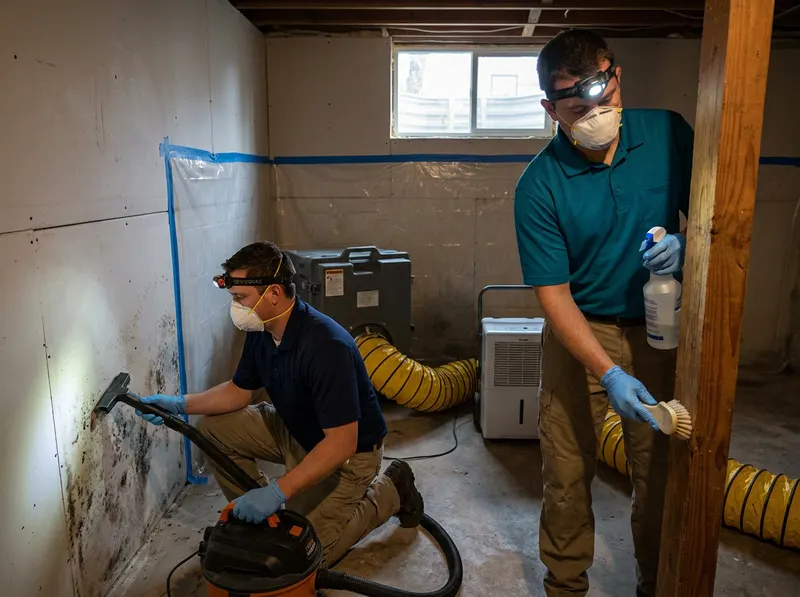
Mold after water damage is not the same job as a standard mold inspection. Remediation begins only after the water source is stopped and the structure is being dried, because mold regrows on any surface left above 16% moisture. Denver's semi-arid climate keeps outdoor humidity low most of the year, which slows mold, but sealed basements below grade in neighborhoods like Washington Park, Platt Park, and Berkeley trap moisture from foundation seepage and slab leaks, and that is where post-flood mold most often takes hold.
Containment is the first physical step. Plastic sheeting seals the work zone, a negative-air machine with a HEPA filter pulls spores outward instead of letting them drift into clean rooms, and porous materials that stayed wet longer than 48 hours, drywall, carpet pad, insulation, MDF trim, are cut out and bagged rather than cleaned, because spores embed in the material and return. Non-porous framing, concrete, and studs are HEPA vacuumed, wire-brushed or sanded where growth is set in, then treated with an antimicrobial. A moisture meter reading confirms the cavity is dry before any wall goes back up.
The right scope depends on how much drywall shows staining. If growth covers less than about 10 square feet on a single wall, a common result of a supply-line drip under a Capitol Hill kitchen sink, a contained spot removal handles it in a couple of days. If the growth follows a whole basement wall line after a spring snowmelt flood off the foothills, the job needs full containment, several days of air scrubbing, and staged drying. The trade-off is straightforward: a small contained job costs less and finishes fast but only fixes what is visible, while a full basement remediation costs more and takes longer yet removes hidden growth behind baseboards and inside stud bays before it spreads.
A post-water-damage mold job in Denver runs in a predictable order: stop and verify the water source is off, set containment and negative air, remove and bag unsalvageable porous materials, HEPA-clean and treat the remaining framing, run drying equipment until the meter reads below 16%, then a clearance check before rebuild. One point that surprises homeowners: the remediation price usually excludes the rebuild, replacing the drywall, texture, paint, and flooring that came out is a separate estimate, so a $2,000 remediation on a bedroom can carry another $1,500 to $3,000 in reconstruction. Remediation removes and dries; it does not repaint the room.