Water Damage Restoration Denver

Frozen & Burst Pipe Water Damage Restoration Denver

A burst pipe fails when water inside freezes, expands about 9% by volume, and forces pressure against a fixed section of pipe until a joint or run splits. In Denver the most common failure points are hose bibs on the…

Get My Free Estimate →
Frozen & Burst Pipe Water Damage in Denver, CO
Quick answer
  • Included: leak shutoff, water extraction, moisture mapping, structural drying with air movers and dehumidifiers, antimicrobial treatment, and drywall/insulation removal where saturated.
  • Speed: crews typically reach Denver-metro addresses within 60, 90 minutes; drying runs 3, 5 days depending on how far water traveled.
  • Cost: most frozen/burst pipe jobs run $1,500, $6,000; single-room clean water losses fall near the low end, multi-floor losses near the high end.
  • What we handle: extraction, drying, and demo of unsalvageable material; the plumbing repair itself is a licensed plumber's scope, coordinated separately.
  • Booking: call the number on this page; a photo of the affected area and the shutoff valve helps size the response.

A burst pipe fails when water inside freezes, expands about 9% by volume, and forces pressure against a fixed section of pipe until a joint or run splits. In Denver the most common failure points are hose bibs on the north and west exterior walls, copper lines in unconditioned attic space in older Baldwin/Congress Park bungalows, and PEX or copper in garage ceilings across Green Valley Ranch and Stapleton-era builds. A quarter-inch crack in a pressurized 1/2-inch line can release upward of 100 gallons per hour, so the first restoration step is closing the main and documenting the source before any water is removed.

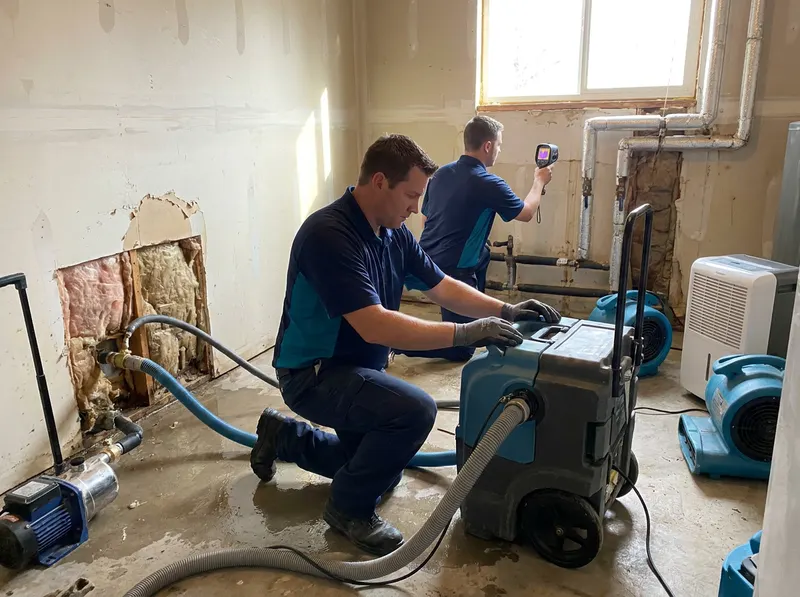
Restoration follows a set sequence. First, the water source is isolated at the main or the affected fixture valve. Second, standing water is extracted with truck-mount or portable units. Third, technicians map moisture with a pin or pinless meter and a thermal camera to trace water inside wall cavities and under flooring, water from a second-floor bathroom line, for example, routinely tracks down interior walls into a finished basement in a Wash Park two-story. Fourth, wet drywall, insulation, and pad that read above dry-standard moisture content are removed. Fifth, air movers and LGR dehumidifiers run 3, 5 days until framing returns to the dry standard, verified with daily meter readings.

Category matters for scope and cost. A supply line that bursts carries clean (Category 1) water, which is the least hazardous and often allows more material to be dried in place rather than removed. Water that sits more than 48, 72 hours degrades toward Category 2, and a burst line above a bathroom that pushes through sewage lines can escalate further, each step up adds antimicrobial treatment and more demolition. If the burst is caught within hours and involves one room, in-place drying keeps the job near $1,500, $2,500; if water traveled through two floors or sat overnight, expect demolition, containment, and a range toward $4,000, $6,000.

Restoration is distinct from repair: a restoration crew dries the structure and removes ruined material, while a licensed plumber replaces the failed pipe section. The two scopes run in parallel, drying can begin the moment the water is shut off, before the permanent plumbing fix is scheduled. Denver homeowners on freeze-prone streets often add pipe insulation and a heat cable to exterior-wall runs after a loss to reduce repeat failures; this preventive work is a plumber's scope, not restoration.
Frozen & Burst Pipe Water Damage cost in Denver

Single-room clean-water burst, dried in place$1,500, $2,500
Multi-room loss with partial drywall/insulation removal$2,500, $4,000
Multi-floor or overnight loss with demolition and containment$4,000, $6,000
Emergency water extraction only (per visit)$400, $900
Structural drying equipment (per day, typical setup)$100, $250

Every job gets a firm, written price after a free on-site visit.

Common questions

How fast can a crew reach a burst pipe in Denver?
Crews typically reach Denver-metro addresses within 60, 90 minutes for burst pipe emergencies. Before arrival, closing the main shutoff, usually where the line enters the basement or crawlspace, limits how many gallons escape while the crew is en route.
What does frozen pipe water damage restoration cost in Denver?
Most frozen and burst pipe restoration jobs in Denver run $1,500, $6,000. A single-room clean-water loss caught within hours sits near $1,500, $2,500, while a loss that traveled through two floors or sat overnight runs toward $4,000, $6,000. The exact figure is confirmed on-site after moisture mapping; the ranges are ballparks.
Does the restoration include fixing the broken pipe in Denver homes?
No, restoration covers water extraction, structural drying, and removal of saturated material, but the pipe repair itself is a licensed plumber's scope. In Denver the two run in parallel: drying begins once the water is shut off, and the plumber replaces the split section separately.
Which Denver pipes freeze and burst most often?
Exterior hose bibs on north and west walls, copper lines in unconditioned attics of older Baldwin and Congress Park bungalows, and garage-ceiling runs in Green Valley Ranch and Stapleton-area homes fail most in Denver. These sit in unheated space where January lows near 8°F drive the water below freezing.
How long does drying take after a burst pipe in Denver?
Structural drying after a Denver burst pipe typically runs 3, 5 days. Air movers and dehumidifiers run until framing and drywall return to the dry standard, verified with daily moisture-meter readings; multi-floor losses where water reached a basement can extend past 5 days.

Get started today

Tell us about your frozen & burst pipe water damage job in Denver and we'll send a clear, written quote, usually the same day.

Get your free water damage restoration quote, Denver

We only use your ZIP to check availability, no spam.